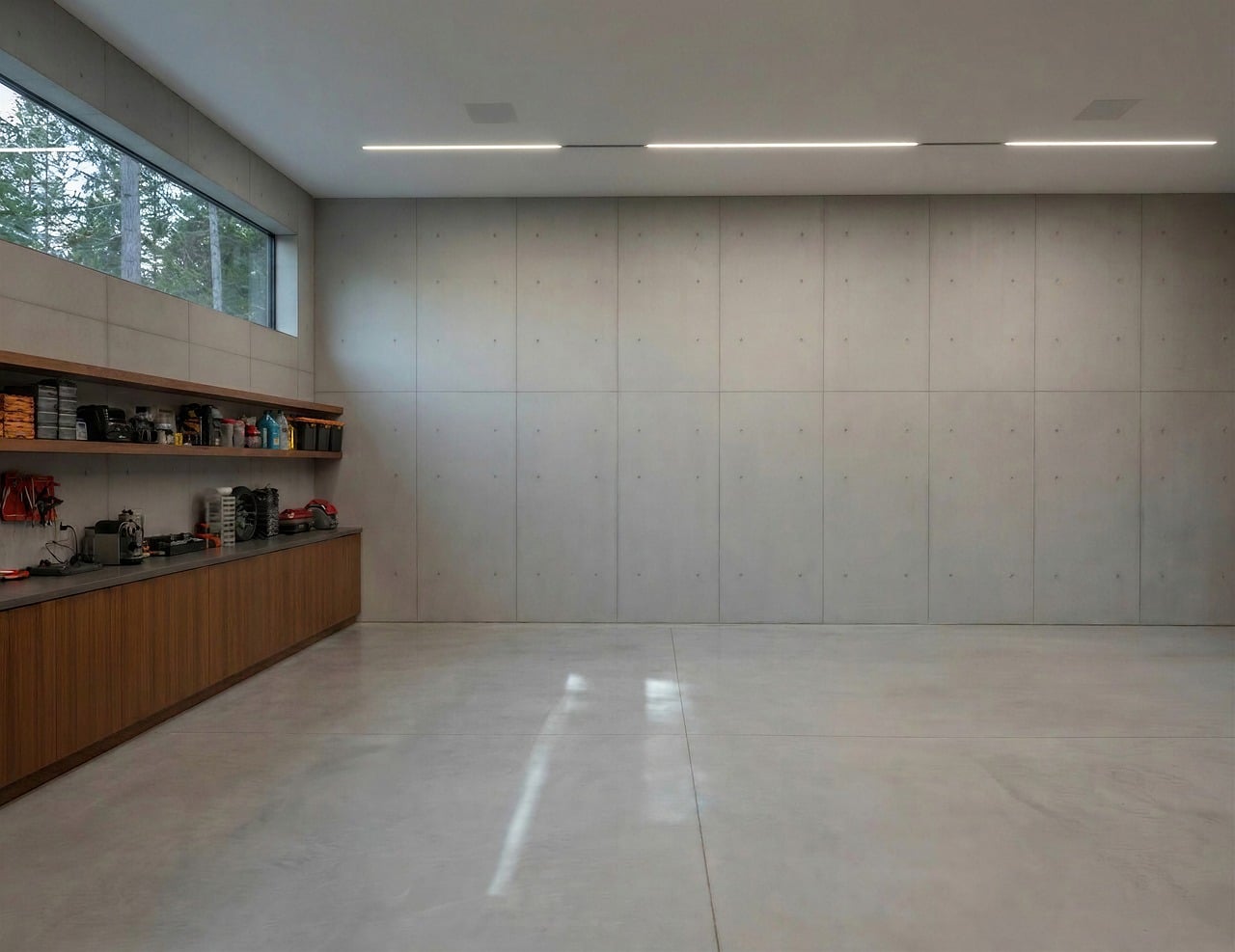
Garage floor coating in Centennial, CO seals a bare concrete slab under a thick, bonded system that resists stains, salt and hot tires. It’s for Centennial homeowners whose garage floors are dusty, oil-stained, pitted near the door or covered with a peeling DIY kit. The work starts with diamond grinding and crack repair, then layers a base coat, decorative flakes and a clear UV-stable topcoat. You end up with a garage floor that sheds meltwater, wipes clean and looks finished.
What a Garage Floor Coating Includes
A full garage system has several layers, and each one has a job.
- Diamond grinding removes the weak top layer of concrete, old sealers and stains, and opens the surface so the coating can grip.
- Crack and pit repair fills damage with a fast-setting repair material that is ground flush.
- Base coat of epoxy or polyurea soaks into the prepared concrete and forms the main bond.
- Flake broadcast adds color and texture while the base coat is still wet.
- Clear topcoat, usually polyaspartic, seals the flakes and resists chemicals, scuffs and sunlight.
Each step depends on the one before it. A strong topcoat over poor prep will still fail.
Signs Your Garage Floor Is Ready for a Coating
You may want to coat your garage if you notice:
- Gray dust that tracks into the house or settles on everything stored in the garage.
- Oil, transmission fluid or rust stains that won’t wash out.
- Rough, flaking spots near the door, where snow and slush melt off the cars.
- A DIY coating that’s lifting in tire paths.
- A floor that looks unfinished next to an organized garage with cabinets and storage.
Why Centennial Garage Floors Break Down
Several local conditions work together against bare concrete:
- De-icing chemicals. Snowmelt dripping off cars carries magnesium chloride and salt from treated roads. These soak into the pores of the slab.
- Freeze-thaw cycles. Water in those pores expands as it freezes. Repeated cycles lead to scaling and pitting, often in a band near the door.
- Hot tires. After a drive, tires can soften weak coatings and pull them up.
- Sunlight. Strong sun at altitude can yellow standard epoxy where the door opening lets light in.
A properly built coating seals the surface so water and chemicals stay on top, and a UV-stable topcoat holds its color.
The Process From Start to Finish
- Clear the garage. We’ll let you know what needs to be moved before the work begins.
- Test and inspect. We check the slab temperature and moisture and look for cracks or old coatings.
- Grind and repair. Diamond grinding opens the surface, and repairs are made flush with the floor.
- Base coat and flakes. The base coat is applied and the flakes are broadcast to the chosen coverage.
- Scrape and topcoat. Loose flakes are removed, and the clear topcoat seals the floor.
- Cure. You’ll get clear guidance on when to walk on the floor and when to park on it.
What Affects the Cost of a Garage Coating
Every garage is different. The main factors are:
- Size of the floor and whether stem walls and the house step are included.
- Condition of the concrete, including cracks, pitting and scaling.
- Old coatings or sealers that need to be ground off.
- Moisture in the slab, which may call for a special primer.
- The system chosen, such as flake coverage and the type and number of topcoats.
- Access and storage, including how much needs to be moved.
Because two garages of the same size can need very different prep, we price each one after seeing the slab in person, at no charge.
Recoat or Start Over?
If an existing professional coating is intact but dull or scratched, it may only need a light sanding and a fresh topcoat. That approach works when the original bond is still solid.
If the coating is peeling, bubbling or lifting in the tire paths, recoating won’t help. The new layer would only be as strong as the failing one under it. In that case, the old coating is ground off and a new system goes down on clean concrete. If you want to coat other areas of the home too, see our metallic epoxy floors for basements and living spaces.
What Happens If You Wait
Scaling and pitting don’t reverse. Each winter adds more salt to the concrete and more damage near the door. Over time, the surface can become rough enough that it needs more repair before any coating goes on. Coating a garage while the concrete is still in fair shape keeps the prep simpler.
Related services in Centennial